3. SB page 14-15 do the matching task on the text. Retell the text, using linking phrases.
4. Watch the video and prepare a 2-minute talk on the topic (which you should first send for a check in writing): What is one of the most amazing technologies you have recently heard about. Use: - to allow Ving - to allow smb toV1 - to help smb V1 - to enable smb to V1 - to save smb from having to V1 = избавить кого-либо от необходимости делать что-то
The November Project
Maggie Lake (New York): Workout ads! They are everywhere you look! As people worldwide grow more conscious of their waistlines, the fitness industry has exploded. Companies promising to whip us into shape, rated an impressive 8 billion dollars last year! But not everyone believes you have to spend money to be healthy. Members of one unique workout group say all you really need is an alarm clock. It’s almost 6.30, the sun is just coming out and we are heading to meet The November Project people.
The November Project meets early morning twice a week at various landmarks around New York. There is no membership fee and workouts are totally free. Brogan Graham and Bojan Mandaric started the project two years ago with the fellow members in Boston. The two just wanted to stay in shape without the expensive crowds of the gym. The movement has exploded from there.
Bojan Mandaric (co-founder): It’s the comradery; it’s the sense of community that we built, we interact with people.
We go humane, sweaty. We are coming for sweaty hearts, we are coming for high buzz here and there. And that’s the community that people like, that’s the community that people get up for when the alarm goes off, it’s so easy to switch this button off. Then all right, I know my friend is going to be right there. I’m gonna come out, I’m gonna have an amazing workout.
Maggie: It is so easy to switch that button off as we found out this morning. This is in sharp contrast with a lot of other fitness ideas that involve a lot of money. You can spend a lot of money trying to get fit.
Bojan: Absolutely. Which is kind of counter-intuitive, because people have been moving and have been working out since the dawn of time. And we got to the point where in order to be healthy and fit you need to spend a lot of money. We need to eat healthy food, we need to pay a lot of money for the gym memberships. We believe it’s kind of backwards, we should be able to use the city as our playground. And we are 19 cities right now, wanting to be 25 maybe even 30 by the end of the year. And it’s just very exciting.
Maggie: Sponsors have taken notice. North Face has partnered with the group saying, “November Project has been at the forefront of the free fitness movement, and has inspired thousands of people to get outside, be more active and have fun doing it. We are both proud weatherproof brands – training no matter what the conditions.”
A dedicated friendly atmosphere but what about results?
I am tired!
Let’s just say sometimes… the best things in life are free.
Questions 10–22. Choose ONE answer, A, B, C or D, for each question.
10. Why does Maggie cite the figure of $8 billion?
Answer: C. The figure frames the wider commercial market. A transfers industry revenue to the group; B confuses revenue with an advertising budget; D turns a reported past figure into a forecast.
Answer: D. They wanted to stay in shape without the expense and crowds of a gym. A invents a competition; B imports the later sponsorship into the origin story; C mistakes later growth for the initial aim.
12. Which description of the New York gatherings is supported?
Answer: A. The report specifies twice-weekly meetings at various landmarks. B changes frequency and location; C substitutes months for weeks and adds “every single”; D invents individual scheduling.
13. How do the initiative’s origins relate to the gathering Maggie visits?
Answer: C. The beginnings were in Boston; Maggie is in New York. A reverses the direction; B invents separate organisations; D reverses the chronology.
14. How does Bojan account for people turning up despite the hour?
Answer: D. The expected presence of a friend helps someone resist turning off the alarm. A invents formal supervision; B borrows the sponsor without evidence of rewards; C invents a ranking.
15. Which assumption about becoming healthy does Bojan dispute?
Answer: B. He calls the supposed need to spend heavily counter-intuitive. A twists his reference to food; C is not his stated target; D is consistent with his emphasis on community.
16. What does Bojan mean by treating the city as a playground?
Answer: C. He proposes using the urban environment itself. A adds a prerequisite; B takes the metaphor literally; D turns an example into an exclusive rule.
17. What is the relationship between the figures Bojan gives for the initiative’s reach?
Answer: A. Nineteen cities is the present figure; twenty-five or thirty are hoped-for totals later that year. B, C and D all erase the current-versus-future distinction.
18. What shared quality does the sponsor emphasise?
Answer: C. The sponsor calls both brands weatherproof and describes training regardless of conditions. A adds giveaways; B invents shared management; D contradicts that claim.
19. How does Maggie present her own experience at the end?
Answer: D. She says she is tired, then closes by praising something available for free. A invents measurement; B reverses her conclusion; C supplies a cause she never identifies.
Answer: B. The reporter raises the question of results, but gives only her immediate fatigue, not longer-term evidence. A, C and D are all answered directly.
21. What is implied by the claim that an alarm clock is all a prospective participant needs?
Answer: A. The clock stands for the effort of waking early, not a purchase requirement. B literalises the device; C invents personal scheduling; D adds an unsupported condition to free access.
22. Which statement best captures the report as a whole?
Answer: C. The piece contrasts expensive fitness offers with a free group whose appeal includes community and use of the city. A and B claim unproved superiority; D invents a government funding solution.
Total Questions: 0
Incorrect Answers: 0
5.2. Using the information from the script above, prepare an answer to the following IELTS speaking 2 question:
Describe an article or book that inspired you to do something.
You should say:
what the article or book was and where you came across it
what it was about and what its main point was
how it influenced you
and explain why it made such a strong impression on you.
come across something — find something unexpectedly
resonate with somebody — have a strong personal meaning for somebody
shed light on something — help people understand something better
put an idea into practice — begin using an idea in real life
be a real eye-opener — reveal something surprising or previously unknown
Grammar patterns
What inspired me most was the way the author...
Not only did it make me think about..., but it also encouraged me to...
Had I not read it, I might never have...
It was after reading it that I decided to...
Universal starters
I’d like to talk about an article/book that...
The first example that comes to mind is...
To give you some background,...
If my memory serves me correctly, I first came across it...
Universal conclusions
Overall, it left a lasting impression on me because...
Looking back, I can say that it changed the way I...
All in all, it was much more than just an interesting read.
That is why this article/book still stands out in my mind.
6. Write an essay on the topic: Are gyms really that important for a healthy living? Outline the main stereotypes people have about fitness and ways to make it free and even more enjoyable.
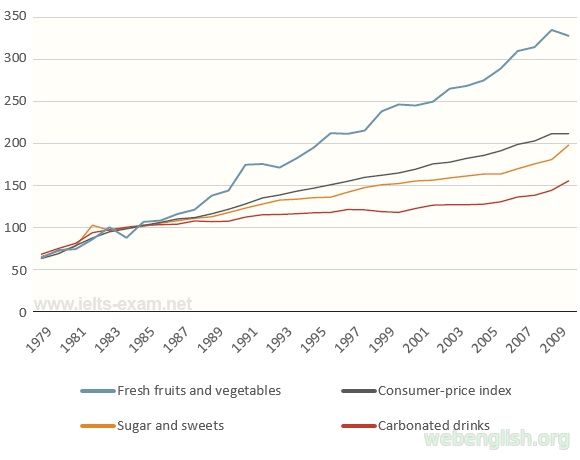
The graph the changes in the prices of fresh fruits and vegetables, sugar and sweets, and carbonated drinks over a thirty-year span in the United States, from 1979 to 2009. It also the overall trend in the consumer price index during this period.
While the consumer price index a gradual and consistent rise throughout these three decades, the trajectory of carbonated drink prices significantly. After a increase between 1979 and 1981, the prices of soft drinks remained relatively until 1999, at which point they began to at a slower pace.
In contrast, the price of fresh fruits and vegetables displayed a different pattern. Despite occasional , their cost rose consistently over the thirty years. Notably, fresh produce prices only briefly from 1990 to 1992 and again between 2000 and 2001. By 2008, however, the price of fresh fruits and vegetables had by over 300%.
Total Questions: 0
Incorrect Answers: 0
2. Write your own description of the graphs below in one answer.
You should spend about 20 minutes on this task.
The graphs below show average monthly spending on children's sports and kids' participation on three different sports between 2008 nand 2014.
Summarise the information by selecting and reporting the main features, and make comparisons where relevant.
Take one minute to prepare a talk on the following subject.
Take notes if you like and remember to include reasons and examples.
You should then speak for between one and two minutes.
1.
Describe an exciting competition or sporting event you have witnessed.
Paraphrase the question: Restate the question in different words to demonstrate understanding. Example phrases:
"The significance/relevance/salience of [topic] has been a subject of extensive debate."
"There is growing concern regarding [rephrased question]."
"In recent years, the topic of [topic] has become increasingly pertinent."
"Few topics generate as much discussion as [topic], given its [importance/consequences]."
Outline sentence: Clearly state your stance or the focus of the essay. Example phrases:
"This essay will explore [restate the question] and argue that [your stance or conclusion]."
"While some believe that [state an alternative opinion], this essay will argue that [your stance]."
"This essay examines the stereotypes surrounding [restate the topic] and considers ways to address them."
"Apart from [initial aspect], [subject] also involves [outline benefits, drawbacks, or features]."
2) Main Body Paragraph 1 – Primary Argument or Perspective
Topic sentence: Introduce your answer to the question with your first main idea. Example phrases:
"A prevalent stereotype surrounding [topic] is that [state stereotype]."
"To address the question, it is important to consider [state answer]."
"The primary benefit/drawback of [topic] lies in [specific idea]."
"One of the most compelling aspects of [topic] is [main feature or argument]."
Explanation: Expand on your reasoning with logical arguments. Example phrases:
"This assumption is often perpetuated by [cause or reason]."
"However, evidence suggests that [counterargument or support]."
"This is particularly true when [specific condition or scenario]."
"This is because...."/li>
Example: Provide a relevant example or evidence. Example phrases:
"For instance, [specific example or case]."
"A case in point is [real-life situation]."
"Statistically,...."
3) Main Body Paragraph 2 – Secondary Perspective or Implication
Topic sentence: Develop your answer further by introducing a related but distinct idea. Example phrases:
"Apart from the aforementioned aspect/drawback(s)/benefit(s)/adverse effects on...etc, [subject] also encompasses [another benefit/drawback]/entails...."
"Expanding on this, it becomes evident that [state further analysis or implication]."
"Examining [specific perspective or factor] highlights that [state insight]."
Explanation: Provide supporting arguments or delve deeper into your idea. Example phrases:
"For example, [specific evidence or proposal]."
"Such initiatives not only [state benefit] but also [state additional benefit]."
"This can be attributed to [specific factor]."
"This has been observed in individuals who... / when... "
Example: Include evidence or a real-life situation to reinforce your point. Example phrases:
"For instance, [specific example]."
"This phenomenon can be observed in [specific scenario or trend]."
4) Main Body Paragraph 3 – Addressing Alternatives or Broader Implications (optional)
Topic sentence: Add a nuanced or alternative perspective to strengthen your argument. Example phrases:
"Although the preceding arguments focus on [primary perspective], it is equally important to consider [alternative perspective]."
"An additional aspect worth exploring is [state broader implication]."
"While [specific argument] holds merit, one cannot overlook [alternative idea or challenge]."
"That said, [an opposite idea]."
"That (being) said / Even though there are downsides, ...may still... / should not by totally discarded / ...holds certain merits/risks/etc to itself "
Explanation: Develop this perspective further with logical reasoning or examples. Example phrases:
"This can provide a more balanced approach to [topic]."
"Moreover, addressing [alternative perspective] ensures [specific outcome or benefit]."
"This view is supported by [specific evidence or reasoning]."
"Particularly, ... / FOr example,... "
Example: Provide a specific example to strengthen your argument. Example phrases:
"For example, [specific case or evidence]."
"This is particularly evident in [real-life situation or example]."
5) Conclusion
Summarize your answer: Recap the main points and provide a final perspective. Example phrases:
"In conclusion, this essay has explored the stereotypes about [topic] and demonstrated how [solution or insight]."
"Ultimately, while [restate key insight from your argument], it is also crucial to recognize that [secondary insight or implication]."
"By addressing these concerns, [topic] can be made both more accessible and enjoyable."
"In sum, [restate your main arguments succinctly]."
"To sum up, ... still seems/tends to V1. Indeed,... / After all, ( additional idea)"